CHAMPAIGN, Ill. — Every plant, animal or other nucleus-containing cell also harbors an array of miniature “organs” that perform essential functions for the cell. In plants, for example, organelles called chloroplasts photosynthesize to generate energy for the organism. Because some organelles contain their own DNA and resemble single-celled organisms, scientists have long theorized that the evolution of complex life forms got its start when one cell engulfed another and the two learned to live in harmony – eventually forming, and belonging to, a single entity.
In a new study published in the journal Nature Communications, scientists reported that they have recapitulated this early event – called endosymbiosis – in yeast.
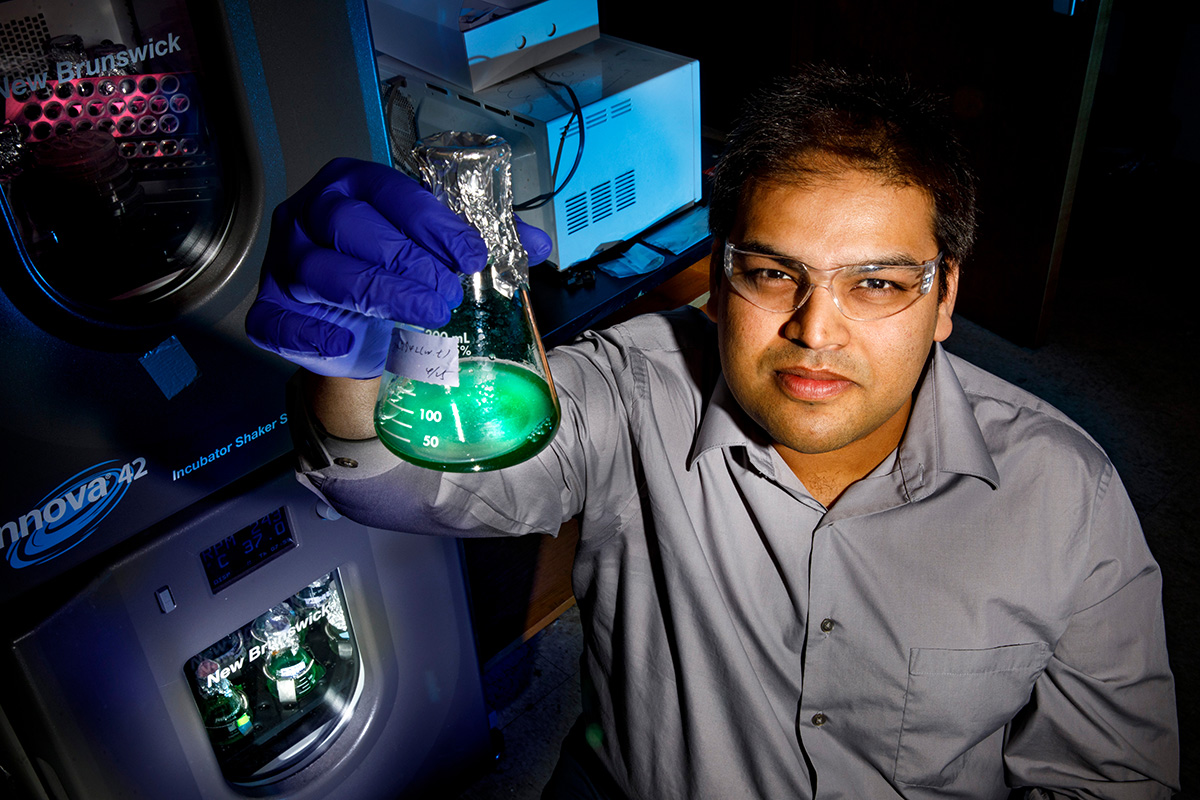
“We have designed and engineered artificial, genetically tractable, photosynthetic endosymbiosis between photosynthetic cyanobacteria and budding yeasts,” said University of Illinois Urbana-Champaign chemistry professor Angad Mehta, who led the research. “And the engineered cyanobacteria perform chloroplast-like functions to support the growth of the yeast.”
These combined life forms, called chimeras, survived and even reproduced by budding under optimal photosynthetic conditions, the team reported.
“They are able to propagate through at least 15 to 20 generations of growth,” Mehta said.
The evolutionary origin of life forms known as eukaryotes – a category that includes plants and animals but also yeast and few other single-celled organisms – is still a mystery, but many scientists believe that endosymbiosis opened the door to the evolution of these complex life forms, Mehta said.
“We have essentially converted a nonphotosynthetic organism into a photosynthetic, chimeric life form,” he said. “I believe that our new ability to build controlled, synthetic endosymbiotic chimera that can be genetically and metabolically manipulated, analytically studied and imaged, and computationally modeled and predicted will break the gridlock on our understanding of this remarkable evolutionary transformation.”
The Moore–Simons Project on the Origin of the Eukaryotic Cell and the National Institute of General Medical Sciences at the National Institutes of Health supported this research.
Editor’s notes:
To reach Angad Mehta, email apm8@illinois.edu.
The paper “Engineering artificial photosynthetic life-forms through endosymbiosis” is available online and is open access.
DOI: 10.1038/s41467-022-29961-7
This article was imported from a previous version of the News Bureau website. Please email news@illinois.edu to report missing photos and/or photo credits.