CHAMPAIGN, Ill. — Researcher Ryan Corey recently heard from a friend who teaches at a school where some of the students have hearing loss. The friend wanted to know if he had any ideas to help her communicate with these students while wearing a mask to slow the spread of COVID-19. Corey, who also has hearing loss, did not know what to tell her. So, he headed to the Illinois Augmented Listening Laboratory to look for solutions.

Postdoctoral researcher Ryan Corey
Corey, an electrical and computer engineering postdoctoral researcher under professor Andrew Singer at the University of Illinois Urbana-Champaign, leads a team that studies audio signal processing, especially for listening devices like hearing aids. The results of the team’s new study evaluating the acoustic effects of face masks on speech are published in The Journal of the Acoustical Society of America.

Professor Andrew Singer
“Previous research performed on this subject has focused on medical masks worn in health care settings,” Corey said, “But no one has looked at the acoustic effects caused by different kinds of fabric masks, so that’s where I focused our study.”
The team tested medical masks, disposable surgical masks, masks with clear plastic windows around the mouth, and homemade and store-bought cloth masks made of different fabric types and numbers of layers.
See a video explaining the research here.
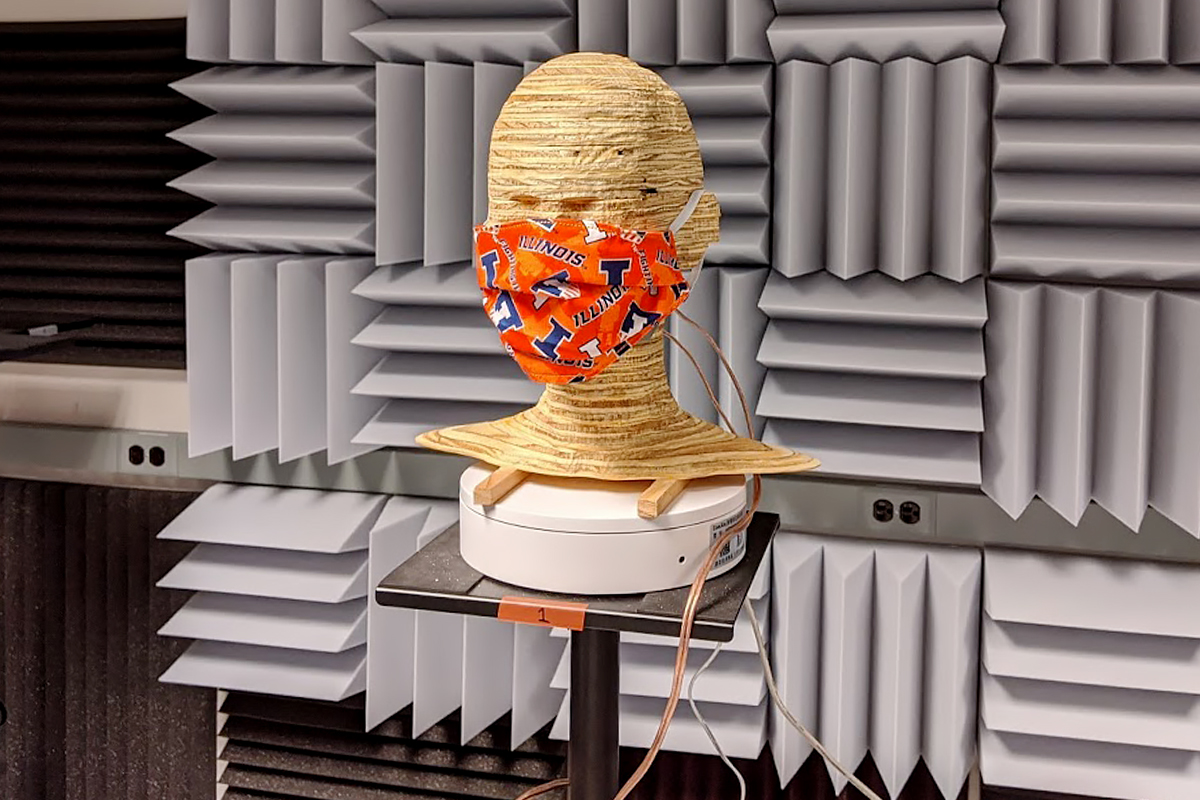
The researchers used a special loudspeaker, custom built by School of Art and Design graduate Uriah Jones and shaped like a human head so that sound radiates as it would coming from a human mouth.
“We put the different masks onto the head-shaped loudspeaker and played the same sound for every test,” Corey said. “We also placed the speaker onto a turntable to add a directional component to our data.”
The team collected data from a mask-wearing human speaker, as well.

“Using a real person makes the sounds less repeatable because we can’t say the same thing the same way every time. However, it does let us account for the real shape of the head and real movements of lips,” Corey said. “Even though these two data sets are a bit different, they both show which sound frequencies are most affected by mask-wearing and which masks have the strongest effects.”
Their data showed that all masks muffle the quiet, high-frequency sound generated when a person pronounces consonants. “Those sounds are already a challenge for those with hearing loss, with or without masks, and even become a challenge for those without hearing loss when you throw a mask into the mix.”

Masks also block visual cues like facial expression and lip motion, so speech reading is no longer an option when wearing most masks. Almost everyone uses speech reading to some extent, with or without hearing loss, Corey said.
“That’s why we tested the clear-window masks that have become very popular,” he said. “Unfortunately, the trade-off is that you can see through them, but they block the most sound of all the masks we tested.”
The study found that disposable surgical masks offer the best acoustic performance among all tested, Corey said. Loosely woven 100% cotton masks also perform well but, as shown in a study by other Illinois researchers, they may not be as effective as surgical masks at blocking respiratory droplets. That study showed that tightly woven cotton and blended fabrics may block more droplets, but Corey’s team found that they also block more sound. Based on the droplet study, Corey suggested that multilayer masks made of loosely woven cotton may offer a reasonable compromise between droplet-blocking efficiency and acoustic performance.
The good news is that most masks do not completely block sound, they simply deflect it away from the mouth. This detail means that simple amplification devices can make masked speech more accessible to everyone. In particular, the lapel microphones that are already used in many classrooms and lecture halls are only mildly affected by face masks. Many hearing aids support remote microphone accessories that are also worn near the lapel.

“Most people do not walk around with lapel mics and amplification systems while wearing a mask, but it can help in settings where it does make sense, like classrooms and meetings,” Corey said.
The U.S. Department of Energy and the Office of the Director of National Intelligence supported this study.
Corey and Singer are affiliated with the Coordinated Science Laboratory. Singer also is affiliated with the Beckman Institute for Advanced Science and Technology and industrial and enterprise systems engineering at Illinois.
To reach Ryan Cory, email corey1@illinois.edu.
The paper “Acoustic effects of medical, cloth, and transparent face masks on speech signals” is available online and from the U. of I. News Bureau. DOI: 10.1121/10.0002279
This article was imported from a previous version of the News Bureau website. Please email news@illinois.edu to report missing photos and/or photo credits.