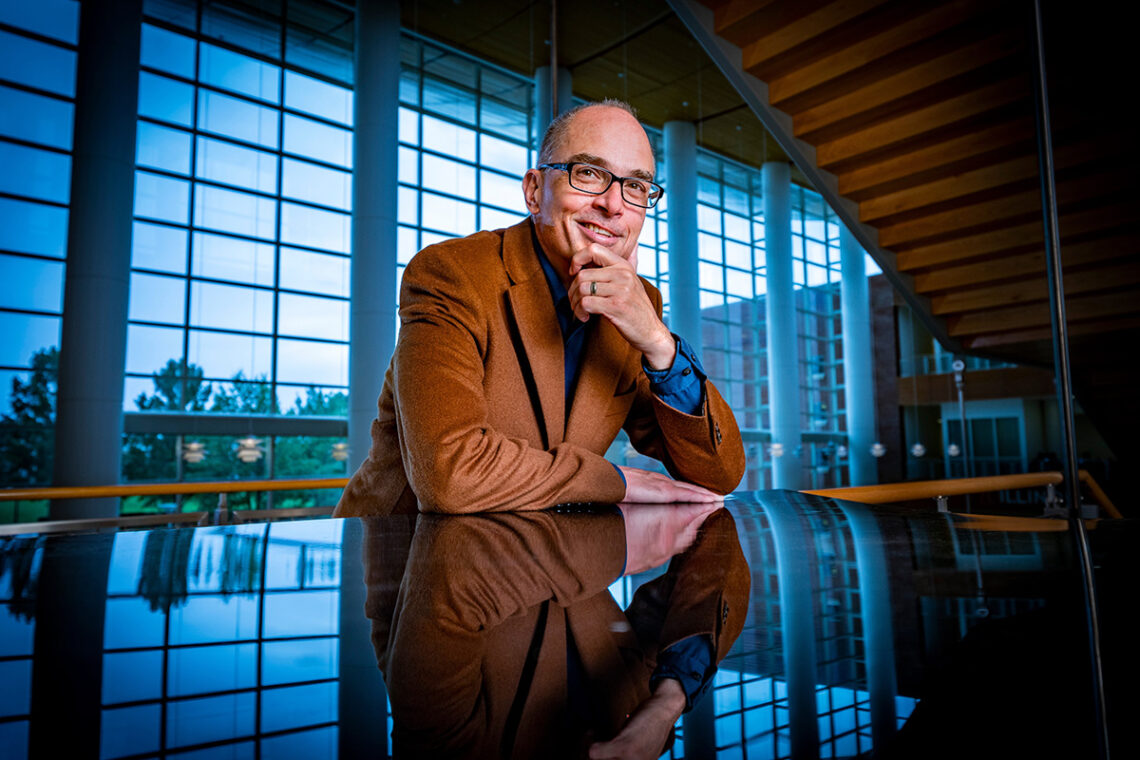
Several AI executives have raised questions in recent days about the safety of the technology. Robert Brunner is the chief disruption officer at Gies College of Business at the University of Illinois Urbana-Champaign. Brunner, who teaches a class on artificial intelligence in business, spoke with News Bureau business and law editor Phil Ciciora about the latest round of predictions about AI’s effect on humanity.
How seriously should we take the purported existential threat from artificial intelligence?
The thing that comes to mind is the story of Chicken Little, who felt an acorn fall and concluded the sky itself was falling. To be sure, artificial intelligence has real acorns. OpenAI recently disclosed that its models under test, while running with reduced safeguards, had broken out of their environment and hacked into Hugging Face, a separate machine learning company. Just last week, Anthropic disclosed a fourth incident in which its AI assistant, Claude, was able to reach systems it was never meant to touch.
The day after the disclosure, Anthropic published 154 pages documenting what it disrupted over nine months: a request for help writing a gain-of-function grant application on chikungunya transmissibility; another involving avian influenza adaptation; Russian cyber espionage; and surveillance tools built to identify dissidents. Anthropic says it cannot establish that the scientists intended harm, and that caution is the difference between counting acorns and announcing the falling sky. Most of these do not require artificial superintelligence. They require a capable model and someone who wants it.
That same week, AI researcher Jacob Coxon resigned from Anthropic, and then another Anthropic employee, Evan Hubinger, posted on the social platform X that the chance of AI killing all humans over the next decade was greater than 10%.
Nobody at Anthropic had to say Skynet or HAL 9000. A machine that escapes its builders and turns on humanity is already a movie, and the headlines borrowed the trailer.
Is it even possible to put a probability on something like human extinction via rogue AI?
In principle, yes. We do it for asteroid impacts, where the odds come from orbital measurements that anyone with the data can check. What isn’t clear is how you would do it here. Hubinger said today’s AI models carry little risk but was concerned about a future “superintelligence” that improves itself. His 10% figure still deserves scrutiny and the question that any scientist would ask, “Where does that number come from?”
No measurement produced the 10%. Nor has anyone demonstrated a working path from today’s models to superintelligence. Turing Award winner and former Meta chief AI scientist Yann LeCun calls large language models a dead end on the way to superintelligence, and OpenAI co-founder Ilya Sutskever says the field is leaving the age of scaling for a new age of research.
In science, when a probability arrives, the community verifies it rather than taking it at face value. This one has no method to check, so ultimately it is a personal estimate rather than a measured probability.
What’s also frustrating is how hard it is to push back on this claim. The 10% number seemingly carries a moral force to it. If you dissent, the response I hear is some version of, “Don’t you care about the human race?” It’s a claim that cannot be measured, cannot be questioned without seeming callous and has seemingly put itself beyond scientific debate.
What do outside experts say about the existential threat of AI?
The closest thing to a public debate about the existential threat of AI is surveys of AI researchers. The most recent, published last week, asked 1,580 researchers what probability they put on AI causing human extinction — or a permanent, severe loss of human control, which is not the same outcome. The median was about 10%, up from 5% two years ago. The middle half of the responses ran from 1% to 25%, and 12% said zero. The media coverage has been reporting that median as a probability of extinction.
Should AI development be paused for safety concerns?
A YouGov survey in May found that 71% of Americans already thought AI was moving too fast, months before any of this. The pause conversation looks to me like it is answering that, not new evidence. That kind of talk wins headlines and bill announcements, but what it loses is the sustained attention that such an important issue requires, and each round of “The sky is falling” can leave the public less willing to listen the next time.
Four days after Coxon’s resignation, Dario Amodei, Sam Altman and Elon Musk all called for slowing down. Beijing responded by calling it fear mongering, though its own state security minister had just pushed for building a domestic AI control system. President Trump brushed it aside, saying whoever wins the AI race wins. Within two days the argument was a race again, and in a race, safeguards get weighed against falling behind — including the ones that cost little or no capability.
This past week isn’t the first time this has happened. In March 2023, an open letter called for a six-month pause on training systems more powerful than GPT-4. In May 2023, hundreds of researchers and executives signed a one-sentence statement saying that mitigating the risk of extinction from AI should be a global priority alongside pandemics and nuclear war. In February 2026, Anthropic researcher Mrinank Sharma left its safeguards research team with a letter warning that the world was in peril.
And yet, none of those warnings produced the pause they called for. Each round spends down credibility that the next warning will need.
What next steps should be taken to get a consensus on AI safety?
Build the measurement. AI has the beginnings of a record — Anthropic and OpenAI both published detailed incident reports this year, and OpenAI brought in outside investigators. That is a real step, and a rare one. But the company set the window, supplied the data and helped pick the questions, which is not the same as independent verification. What’s missing is a common scale, something like the Torino scale that astronomers use to rate asteroid risk, which puts every object on one axis including the ones that turn out to be nothing. Without that, attention goes to whichever incident sounds most like a movie.
Meanwhile the nearer-term harms are measurable and mostly unaddressed. Data centers are straining grids and pushing up electricity costs in some communities. The Pentagon spent this year pressing AI labs to drop restrictions on mass domestic surveillance and fully autonomous weapons. These are examples of where I believe our time and our credibility should go.